Sometimes when you walk on freshly installed pressure treated deck boards you will notice that gaps are forming. Sometimes there may be boards warping. This mostly happens if the deck board has not be provided the right drying time. Moisture content in your deck boards should not be considered a minor detail. It is important to know that it is one of the biggest factors that determine how long your deck will look good. How long it will stay level and safe for usage.
Traditional pressure treated wood contains a lot of moisture. It comes straight from the treatment process. This can cause problems if installed too soon. On the other hand, modern WPC composite decking behaves differently. It is built to be stable and ready for installation immediately. In this article, we will tell you about the deck board drying time, the effects of moisture on deck boards and how to choose the right decking for a long lasting outdoor space.
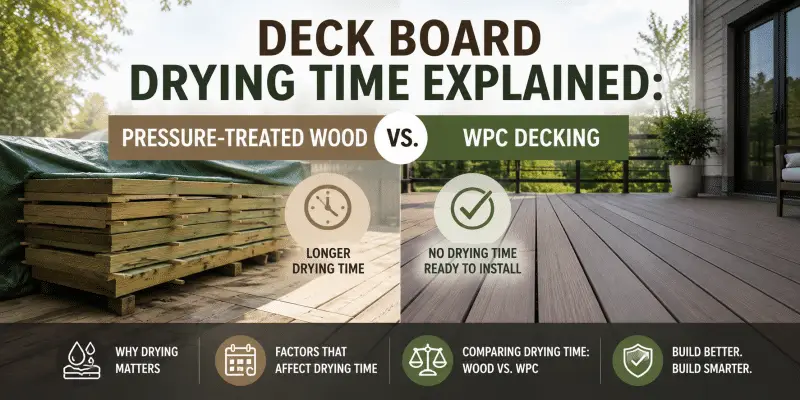
Why Deck Board Drying Time Is Important
Understanding Moisture in Pressure-Treated Lumber
To prevent from rot, insects and decaying, all types of pressure treated lumber is soaked in chemical preservatives. While this is good for keeping the wood safe outdoors, it also leaves the boards with high moisture content.
When boards are too wet during installation, they are prone to shrinkage. They can also warp and even end up cracking as they dry over time.
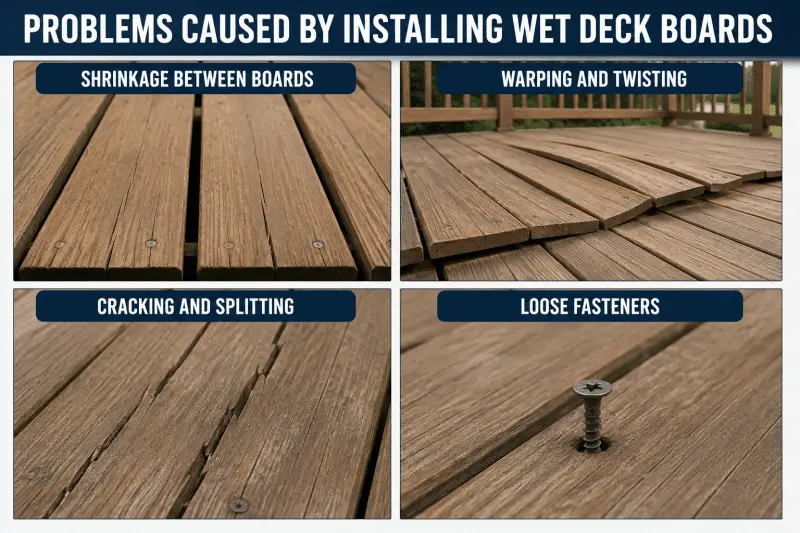
Problems Caused by Installing Wet Deck Boards
If you install boards on your deck before they are completely dry, it can cause several problems. These issues include:
- Shrinkage between boards – You will see that gaps will appear as wood loses moisture and dry in air or sun.
- Warping and twisting – The deck boards will start to bend unevenly. This can make the deck surface uneven and stable to walk on.
- Cracking and splitting – When the wet boards are installed on you deck, stress may be applied. This tension may often cause the fibers to split or crack.
- Loose fasteners – Once the wet boards are installed on you deck, they will dry and shrink eventually. As a result, the screws or nails you have used for installation can loosen with their shrinkage.
These issues not only affect the deck’s overall outlook but they can also compromise safety and require extra maintenance.
Outdoor Climate and Drying Conditions
If there is moisture in wood, it will react with its environment. The key factors that influence drying of the deck boards include the following:
- Humidity
If the humidity is high, the drying process is slowed down.
- Temperature
Higher temperatures or warm weather accelerate the process of moisture loss or drying.
- Sunlight and airflow
Sun exposure and proper ventilation speed up the drying of deck boards.
- Storage conditions
Boards that are stacked on the ground or covered improperly end up retaining moisture more.
How Long Should Pressure Treated Deck Boards Dry?
Average Drying Time for Pressure-Treated Lumber
Drying time of deck boards varies. It depends on the climate, the storage conditions and the thickness of the board.
On an average it takes wet pressure treated wood several weeks to a few months to reach moisture levels where they are fit for installation.
There are also the Kiln-Dried After Treatment (KDAT) boards. They are already lower in moisture. So, usually they are ready to install in a much shorter time.
How to Tell If Deck Boards Are Dry Enough
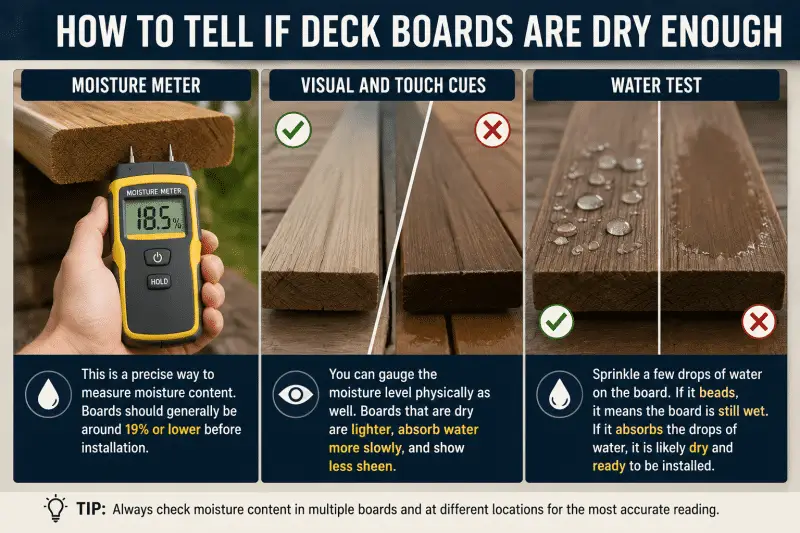
There are a few parameters that help gauge whether a deck board is dry enough for safe installation. These parameters include the following:
- Moisture Meter
This is a precise way to measure moisture content. Boards should generally be around 19% or lower before installation.
- Visual and touch cues
You can gauge the moisture level physically as well. Boards that are dry are lighter. They absorb water more slowly. They also show less sheen.
- Water test
You can take the water to see moisture level in a deck board. Sprinkle a few drops of water on the board. If it beads it means the board is still wet. If it absorbs the drops of water it is likely dry and ready to be installed.
Best Practices for Drying Deck Boards
If you have selected pressure treated lumber for your deck then proper drying is very critical. It can assist in preventing future unwanted problems like warping, shrinking and cracking.
A few simple steps during storage can improve the airflow between the boards. It can also promote even drying and help your boards reach the right moisture level before installation.
- Stack Boards with Spacers
You should place small spacers between boards. This will help air to circulate freely and in turn speed up the drying process.
- Elevate Boards Off the Ground
Always the lumber raised on pallets or supports. This is necessary to prevent it from absorbing moisture from the ground.
- Protect from Direct Rain
Make sure to cover the top of the stack. This will keep it protected from rain. However, make sure to leave the sides open so air can continue flowing through the boards.
- Rotate Boards Occasionally
This is also an important consideration during the drying process. You should turn or rearrange boards from time to time. This is necessary to encourage more even drying across the entire stack.
Why Many Homeowners Choose WPC Composite Decking Instead of Wood
Moisture Resistance Advantages of WPC Decking
WPC also called Wood Plastic Composite boards are manufactured differently than natural wood. They do not absorb moisture the same way as wood. This means:
- There will be minimal expansion or shrinkage
- Less risk of warping or cracking due to moisture loss
- Consistent board spacing
This makes them highly reliable in humid or rainy climates.
Faster and Easier Installation
One of the biggest advantages of WPC composite decking is how simple and efficient the installation process can be.
Unlike pressure-treated lumber, there is no need to worry about moisture levels. You do not have to wait for the boards to dry before getting started.
- No Waiting for Drying
WPC Composite boards are available ready for installation. This helps you start and finish your project faster.
- Consistent Dimensions
Each of the WPC decking board is manufactured to precise specifications. This makes it easier to achieve proper alignment and uniform spacing throughout the deck.
- Less Risk of Post-Installation Movement
Composite decking does not shrink or warp like natural wood. Hence, you will not have to worry about boards changing their shape after installation.
- Suitable for Residential and Commercial Projects
Faster installation and fewer moisture-related concerns can help reduce labor time, making composite decking a practical choice for projects of all sizes.
Lower Maintenance for Outdoor Decks
Many homeowners use composite decking in their backyards because it offers the appearance of wood. At the same time there is no requirement for ongoing maintenance that traditional lumber requires.
- No Annual Sanding, Staining, or Sealing
- Resistant to Mold, Insects, and Moisture Damage
- Easy to Clean
- Retains Its Appearance for Years
Choosing High-Quality Composite Decking for Outdoor Projects
What to Look for in WPC Decking
When selecting composite boards, check for:
- UV resistance
- Color stability
- Durable Manufacturing
- Slip resistance
- Fire and heat resistance
KR WPC Composite Decking Solutions
KR ECO offer high quality WPC decking boards. It combines wood powder and HDPE plastic using precision molds. Through this process KR ECO produces premium high-quality boards that provides multiple benefits including:
- Comfortable and Durable outdoor performance
They are best suited for patios, pool decks, balconies and garden spaces.
- Reliable manufacturing standards
The manufacturing and products of KR ECO are CE and FSC certified. They are also tested for fire and heat resistance.
- Long Term Value
Due to its advanced manufacturing and high quality features, KR WPC Decking boards reduce maintenance, ensure stability in your deck and keeps it looking great for years.
Conclusion
Drying time is one of the most overlooked factors in deck construction. Installing pressure-treated boards too early can cause shrinkage. It can also lead to warping, cracking and other practical maintenance issues with your deck. Outdoor conditions, storage and the type of wood you use all affect drying time. This makes it important to plan your project very carefully.
WPC composite decking eliminates many of the challenges stated above. With immediate installation readiness, minimal shrinkage and low maintenance, it is a reliable choice for homeowners. It is best for those who seek a long-lasting and hassle-free outdoor deck.
By choosing high-quality composite boards, planning storage, and understanding moisture considerations, you can ensure your deck stays safe, stable and beautiful for years.
Frequently Asked Questions
How long should pressure treated deck boards dry before installation?
Generally the pressure treated wood deck boards can take several weeks to a few months for drying completely. It mostly depends on the moisture level of the wood and the weather conditions.
Can you install pressure-treated lumber while wet?
No. Not at all. If you install deck boards that are wet, it can result in warping, shrinkage and cracks.
How do you know when deck boards are dry enough?
You can utilize a moisture meter to check if the board is dry enough. You can also check the weight and surface dryness with water test.
Does WPC decking need drying before installation?
No. WPC composite material is much different than normal wood. It is artificially manufactured and is ready for immediate installation.
Why choose WPC over pressure treated wood?
WPC boards offer several benefits for decking. It has dimensional stability and it is low maintenance. It is easy to install and resistant to moisture, insects and weather damage. Hence, people choose WPC over wood boards.