

Introduction
Commercial importers and distributors are frequently in a challenging situation. You’ve got a composite wood fence system that’s been in the field for years, and you’re now faced with the need to replace some of the components as a result of field damage or phased expansion. The problem is that if you change the tooling during the run, then the new parts won’t work with the existing builds. Changes that are not mentioned usually create project delays and misaligned lines.
Boards that are 1 mm off in replacement blow out joints catastrophically. This article sets up an auditable governance mechanism for qualifying replacements. Treat repeat purchases as stringent formal configuration management to avoid downstream extended warranty claims.
1. Establish a Reliable Record of the Original WPC Fence Order
1.1 Separate the SKU, Product Revision and Production Lot
The SKU is used to track the commercial item and has a different purpose than the Product Revision, which identifies the engineering baseline, or the Production Lot, which monitors the material batch. Purchasing by name often obscures tooling changes, so it increases mismatch risks.
Record key engineering characteristics such as core sizes alongside rib thicknesses and specific color codes. Criteria concerning form, fit, as well as function drive change. It needs a new SKU if it changes interfaces. Capped and uncapped boards of the same dimensions need different SKUs so they don’t look different. All Engineering changes must be certified by suppliers before mass reorders.
1.2 Create a Project-Specific Bill of Materials
Develop a full Bill of Materials for all the structural elements. This will include the composite boards and the aluminum posts, the support rails, brackets, and anchors. The schedule is to be in formal contract style, with item numbers and quantities clearly identified. The whole kits to be kept separate from the individual replacement parts.
Each item to be matched to its point of installation and wind exposure zone. Alloy and finish codes for the hardware to be recorded to avoid galvanic corrosion. Top and bottom rails have distinct load profiles; changing them can lead to disengagement. Review subassemblies with original shop drawings to ensure field alterations have been correctly redlined.
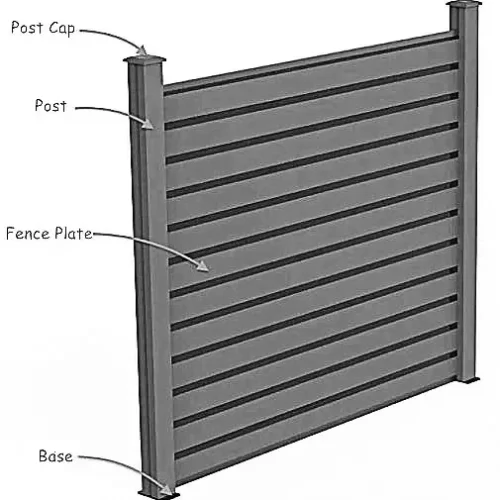
Reference Parts Schedule: WPC Fence Assembly Component Baseline
| Item No. | Component Description | Material & Specification | Function / Interface Detail | Reorder Traceability Reference |
| 01 | Full-Privacy WPC Tongue & Groove Board | HDPE / Wood Flour Core; ASA / Co-Extruded Cap | Interlocking structural infill; tongue-and-groove joint | Master SKU + Rev Level + Color Code |
| 02 | Structural Aluminum Fence Post | Extruded 6063-T5 Aluminum; Powder-Coated | Primary vertical load-bearing member; dual post slots | Extrusion Profile No. + Wall Thickness |
| 03 | Profile-Matched Bottom Rail | Heavy-Gauge Aluminum with Raised Support Crest | Bridges posts, seats bottom board, maintains water drainage | Rail Profile Drawing Rev + Drainage Slot Detail |
| 04 | Top Retaining Finish Rail | Extruded Aluminum U-Channel; Cap Retention Lip | Locks top board in place; retains end-expansion clearances | Profile Dimension Ref + Fastener Interface |
| 05 | Bottom Rail Mounting Brackets | Die-Cast / Formed Bracket; Position-Specific | Transmits dead load and wind shear to vertical posts | Bracket Stamping Mark + Fastener Gauge Spec |
| 06 | Top Rail Expansion Brackets | Formed Aluminum / Stainless Steel; Elongated Slot | Restrains lateral wind load while permitting thermal slip | Hardware Part No. b+ Slide Tolerance Class |
| 07 | Post Anchor Base Plate | Heavy Structural Steel / Cast Aluminum Base | Surface anchors post to concrete foundations (ASTM A36) | Base Plate Drawing Rev + Weld Verification |
| 08 | Fastener Package | Grade 304 / Grade 316 Stainless-Steel Torx Screws | Secures brackets to post walls without galvanic reaction | Fastener Spec Sheet + Thread Pitch / Length |
1.3 Retain Evidence That Supports Future Reorders
Establish a permanent repository for centralized purchase orders. This should also house stamped drawings and mill certificates, alongside technical data sheets. Store labeled reference samples as unweathered baselines in climate-controlled storage. Keep carton labels for resin batch numbers.
Record ambient job site conditions applicable to expansion gap sizing during installation. Keep the manufacturer manuals and warranty confirmations. Record any trim dimensions or jobsite substitutes. Protect distributors in case of disputes, allowing fast spectrophotometer detection between natural weathering and pigment errors. Unweathered samples: Ensure original quality records have certified lab findings for board core flexural strength.
2. Verify Accessory Compatibility Before Approving Substitutions
2.1 Check the Interfaces That Determine Fit
Compare current supplier offerings to original records by checking dimensions alongside extrusion dies and specific raw ingredients. Check to see if post slot widths or tongue profiles have been altered. Consider the board thickness and the coverage height and depth of contact with the relevant channels. Check bracket sizes and fixing hole locations against approved paperwork, while also verifying installation tolerances.
Check if core formulation changed between virgin and recycled mixes, changing flexural stiffness. Think about surface capping technology for material enhancement. A small drop in tongue depth affects wind load disengagement thresholds, resulting in blowouts. Please provide revised section drawings demonstrating key tolerances prior to any repeat bulk order being confirmed.
2.2 Classify the Proposed Replacement
Define replacements using three categories: Direct Replacement, Conditional Modification, and Incompatible Replacement. Direct Replacements are exact in size to the original and structurally sound. Conditional Modifications require documented field changes approved by engineers. Incompatible Replacements have differing geometry and require full bay replacement.
Structural equivalency for design wind loads cannot be established on the basis of smooth physical fit. Substitutions affecting performance require technical validation. Replacing a hollow board with a solid profile increases dead load by forty percent, and bottom bracket shear calculations must be carried out. Bulk material orders should not be released until actual samples are assembled on a test jig.
2.3 Evaluate Appearance Separately from Mechanical Compatibility
Mechanical interchangeability is a very different thing from aesthetic acceptability. Boards may be perfectly interchangeable mechanically and yet produce a very unsatisfactory visual result. You can assess new and worn boards in terms of color and texture as well as gloss and overall profile. Uncapped boards will go through a tannic washout period and then stabilize.
Color variation can be measured using spectrophotometry, and baseline values will be subject to very strict tolerances. Surface texture and gloss will also have to be checked in diffused daylight. Check visual shadow lines for chamfer depth match. When replacing boards, cut out aged portions from unseen corners to restore prominent ones. Require documented customer approval of side-by-side physical sample comparisons before shipment.

3. Plan Spare Parts and Product Transitions Before Supply Becomes Urgent
3.1 Prioritize Spares by Replacement Risk
Prioritize spare parts by assessing installed quantities alongside damage rates, replenishment lead times, and availability. Bottom boards are a high-vulnerability aspect to target owing to mower impacts and water exposure. High-wear parts requiring specific provisioning include gate hardware alongside drop rods and post hinge interfaces.
Use end posts for audits that can handle imbalanced wind shear forces. Don’t forget the proprietary parts like unique rail clips or plastic covers that interrupt the repair work. The hidden wind-holding clamps distort under high wind and fail in subsequent storms. Adjust allocations dynamically, tracking component failure histories.
3.2 Set Stock Levels Around Actual Service Needs
Don’t use random off percentages, as that leads to overstocking of robust posts and understocking of brackets. Separate out your installation contingency stock from your long-term operational maintenance stock. Set your reorder levels on the basis of proven parameters such as minimum order quantities and freight lead times, taking into account site microclimates and storage capacity.
Use intermittent demand forecasting rather than the standard moving average for the slow-moving maintenance items. Consider the supplier’s manufacturing runs where ordering below minimums will result in expensive die setup charges. Hybrid approaches to inventory planning will save capital on holding and will still deliver very high availability. Ensure that spare boards are stored flat in the facilities on continuous dunnage spacers to prevent them from sagging irreparably.

3.3 Agree on a Process for Revised or Discontinued Components
Clarify final order opportunities alongside tooling requirements and approvals for replacement systems before supply becomes critical. Include contractual clauses that require suppliers to notify you of product changes 90 days before changing tools or formulations. Require these notices to detail impacted SKUs and implementation dates, along with backward compatibility and available replacement paths.
Define specific protocol terms, including last-time buy options before legacy dies are fully retired. Put retention contracts in place for tooling. When retiring old profiles, use deterioration curves to compute buy amounts. Ensure written commitments are in place detailing minimum retention periods for all post-production tools on all commercial fence projects.
4. Control Reorders Across Multiple Deliveries
4.1 Confirm WPC Fence Supply Details with the Supplier
Project reviewers must specifically ask for the model drawings, physical sample sets, and current installation manuals as part of the submittal. When evaluating these materials, partnering with a reliable supplier is essential. KR WPC is a major manufacturer of composite fencing panels as well as aluminum posts and matching accessories. Visit their website: krecocomposites.com. When you’re looking at the frames, the conversation should be about confirming the current profiles and matching accessories and identifying the codes so that you can re-order them in the future.
Present the component availability as a series of technical checks for each project rather than as a guarantee of a permanent service. Check the drawings for section, manufacturing tolerances, and minimum order quantities on repeat orders. Check the production and shipping times. If the supplier doesn’t have dedicated extrusion lines, then be mindful of the increased tolerance variation that is possible in the intermittent batch setup. Get a written confirmation of the die numbers and the resin formula code. In the end, sourcing directly from an extrusion manufacturer in this way enables the buyer to get custom length boards, which in effect can reduce site waste by as much as 15%.
4.2 Release Each Reorder Against an Approved Package
Do not place repeat orders from verbal requests, generic catalog names, or copies of invoices. Develop an auditable Reorder Approval Package. This must include all original contract references and required SKUs, alongside drawing revision numbers, exact quantities, and approved delivery locations.
Ensure the inclusion of dimensional drawings alongside variance waivers and physical appearance limits. Formal written supplier acknowledgment of the entire technical package prior to release for manufacturing. Establish quality inspection points within production, such as inline dimensional checks and before-shipment audits. Pilot run clauses to validate samples prior to releasing container balances. Include an agreed-upon verification checklist in the official purchasing contract.
Sample Reorder Checklist
| Audit Item | Baseline Requirement | Verified Order Data | Verification Method | Sign-Off / Approval Status |
| Part Number (SKU) | Exact matching orderable SKU | e.g., KR-WPC-FB-160 | PO & catalog cross-check | Approved / Pending |
| Revision Level | Approved engineering version | e.g., Rev. C (CAD Ref: #842) | CAD drawing overlay | Approved / Pending |
| Quantity Ordered | Net project requirements + spares | e.g., 450 pcs (30 bays + spares) | Itemized BOM verification | Approved / Pending |
| Production Lot / Batch | Documented factory batch run | e.g., Lot #2026-B08-HDPE | Carton label & mill cert | Approved / Pending |
| Dimensional Fit Check | Critical tolerances within | Tongue thickness & groove depth | Dial caliper site check | Approved / Pending |
| Structural Confirmation | Required if substitution made | Signed engineer confirmation | PE structural review | Approved / Exempt |
| Aesthetic / Color Match | Spectrophotometer | Verified against master sample | Optical comparison / lab report | Approved / Pending |
4.3 Keep Delivered Components Traceable Through Installation
Suppliers must use carton labeling which includes part numbers and revision codes as well as lot numbers and project phases. Formal receiving audits must be carried out whereby the incoming tags are compared to the approved reorder package. Off-spec dimensions and unapproved substitutes (including any unnotified profile variations) must be immediately segregated to prevent inadvertent installation.
Keep physical batch separation in staging at the warehouse. Never mix old and new manufacturing runs. During installation, record specific lots and update permanent project records. Lot marking is traceable. This helps avoid systemic warranty disputes, identifying if failures are isolated errors or a batch problem. Check delivery notes against corresponding part numbers.
Conclusion
The key to successful reorders across multi-year projects is moving beyond generic descriptions. Instead, focus on strict SKU configuration control alongside validated mechanical compatibility and calculated spare stocks.
Binding technical assets consist of initial records and master CAD designs, as well as lab reports and physical samples. Written engineering verification is required before permitting field installation substitutions. Work with manufacturers like KR WPC (krecocomposites.com) prior to breaking ground. This helps establish baselines and evaluate profile drawings, while also finalizing special ordering arrangements.
FAQs
What should buyers do when an original fence accessory is discontinued?
Get the formal engineering drawings for the proposed alternatives, check the assembly for compatibility, confirm that the wind load resistance is still there, and test a sample assembly prior to releasing the bulk orders.
Which WPC fence components should be kept as spare parts?
Focus on the high vulnerability items: the bottom fence boards (exposed to ground moisture), the gate hardware, the fence post mounting brackets, and the plastic end caps.
How many spare fence boards and accessories should a project order?
Base your quantities on the project variables (installation damage, environmental exposure, replenishment lead times, supplier MOQs) rather than some arbitrary universal percentages
How should SKU revisions be managed across phased fence deliveries?
Maintain strict configuration baselines; if a supplier change alters form, fit, or function, assign a new part number and isolate inventory rather than blending mixed revisions on site.
When should a complete fence bay be replaced instead of individual parts?
When the current profile geometry will not interlock with legacy boards, or when visual weathering disparities between new and existing boards exceed project acceptance limits, replace the entire bay.