
Introduction: Why Outdoor Gate Construction Is Entering a New Era
Most gates are built like afterthoughts: two sagging hinges, a few boards, a latch that never lines up once winter hits. Then the house gets a new façade, the fence gets upgraded, and the gate still looks like a 1998 DIY project. That’s not just ugly—it’s a leak in privacy and an annoyance.
Wood planks are the usual suspect. They soak up water, dry out, swell, shrink, split, fade, and demand the ritual of sanding and staining. Skip one season and the grain turns into a complaint.Wood‑plastic composite (WPC) shows up with a familiar look and a less needy attitude. It won’t fix a bad design, though. The next wave of gate building isn’t “swap wood for WPC and call it modern.” It’s frames that stay straight, panels you can replace, hardware that’s serviceable, and entrances that can talk to lights, cameras, and motors—without looking like a science project.
The Gate of the Future Will Be a Hybrid Construction System
WPC As An Exterior Infill Rather Than The Only Structural Component
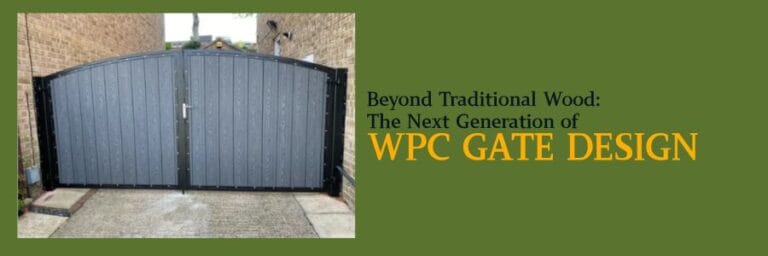
Treat the WPC like cladding. The frame does the hard work. An aluminum or steel perimeter—braced and built to stay that way—carries the weight, the wind shove, and the abuse. The composite boards cover the frame and set the style.
Wide gates are where this pays off. A driveway panel catches wind like a sail, and if the “structure” is boards and hope, you get hinge sag and racking. Plan rail spacing to support the chosen WPC profile, spread loads across the frame, and spec plank thickness and gate width with wind exposure and opening frequency in mind. On leaves like that, add a mid-rail; it stops the infill from drumming in wind and gives you fastening points.
Supporting Different Opening Mechanisms
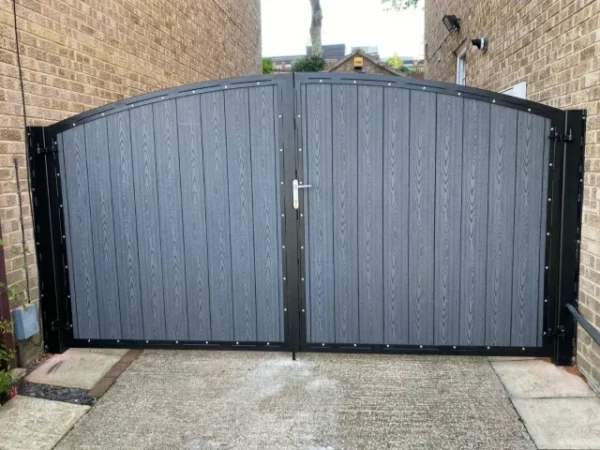
Swing gates want balance. Keep weight reasonable, reinforce hinge and lock areas, and pick plank direction to suit the proportions—vertical for tall/narrow, horizontal for low/wide.
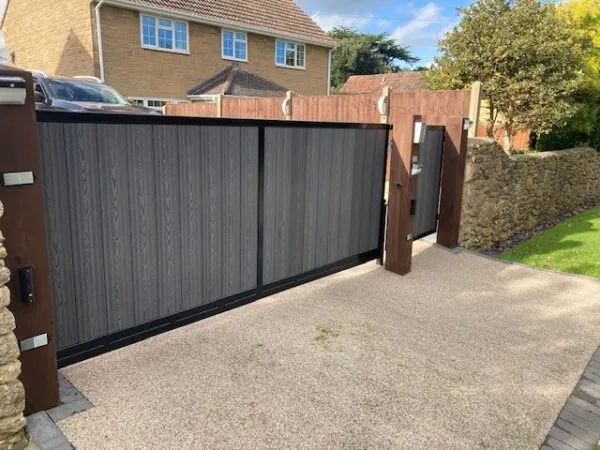
Sliding gates are fussier. Tracks hate debris. Rollers hate misalignment. Leave clearance around wheels and guides, avoid board ends sitting in water-trapping channels, and design removable infill sections so future hardware work isn’t a demolition job.
Preparing WPC Gates For Automation
If automation is even a “maybe,” build for it now: mounting plates, cable paths, keypad wiring, intercom wiring, and access for maintenance. Keep wiring out of hinge lines, and leave space for motor arms, photo-eyes, loop sensors, and a junction box.
WPC Gate Design Will Become More Modular and Architecturally Flexible
Moving Beyond Standard Vertical Boards
Vertical pickets are safe. They’re also boring. Horizontal WPC layouts read cleaner on modern homes because the lines don’t stutter. Board spacing is where you earn your pay: tight gaps for privacy, open gaps for airflow, and a deliberate rhythm instead of “whatever the installer felt like that day.” Mixing widths—say a wide board every third course—adds a designed look without custom fabrication.
Ventilated And Semi-Private Configurations
A gate doesn’t have to be a solid wall. Controlled gaps keep gardens from turning into a mildew box, and louver-inspired angles can block sightlines while still letting wind pass. Handy on driveways and courtyards where a full-privacy slab becomes a wind hammer.
Mixed-Material Gate Concepts
WPC plays nicely with powder-coated aluminum or steel. Use metal trims to hide board ends, add a clean perimeter shadow line, or integrate house numbers and low-glare lighting. If you want it to look intentional, keep reveals consistent, and hide fasteners—face screws are fine, but they should be lined up too.
Creating A Consistent Exterior Material Palette
Match the gate with the fence, then echo that finish on composite decking or composite exterior cladding. One exterior story. Same color, same grain, same orientation. No weird patchwork.
Supporting Replaceable And Upgradable Components
Design the infill as modules. If a forklift kisses the gate, you replace a few boards, not the whole leaf. Renovation later? Swap panels or trims and keep the frame—and the automation—right where it is.
Outdoor Performance Will Shape Future WPC Gate Specifications
Designing For Local Climate Conditions
Rain and humidity punish details, not marketing. Pick WPC profiles meant for full exterior exposure, then avoid the classic mistake: trapping water at board ends inside a frame channel. Give the bottom rail a way to drain, leave ventilation behind the infill, and don’t cap everything so tight it stays wet.
Sun and heat are different problems. Dark boards get hot. Long runs move. Follow the manufacturer’s expansion spacing and don’t crank down fasteners until the board can’t breathe—because it will move anyway, and it will take the frame with it.
Coastal sites are the final boss. The WPC may be fine, but salt air eats hinges, screws, locks, tracks, and motor housings. Spec the frame and hardware as a corrosion-resistant package, not a mix of whatever was on the truck.
Reducing Long-Term Surface Maintenance
The win is skipping the stain-and-seal hamster wheel. Cleaning is usually a rinse, mild soap, and a soft brush. Skip bleach and solvent cleaners, and don’t blast a pressure washer at point-blank range. Then inspect the real moving parts—hinges, rollers, latches—like you actually want the gate to work.
Specifying The Complete Gate System
Panels: size, weight, texture, color, expansion, fastening. Structure: frame material, bracing, span, wind. Operation: swing or slide, manual or automated, service access. Hardware hinge/track capacity, lock type, motor, sensors, future replacement.
WPC Composite Fencing Panels Can Support Coordinated Gate-and-Fence Projects
Using WPC Composite Fencing Panels As Gate Infill
If the fence and the gate come from different planets, everyone notices. The clean approach is to treat the gate as a metal frame that accepts the same WPC fencing profiles used on the run—same grain, same color, same proportions—so the opening reads as part of the boundary, not a patch.
Supporting Different Outdoor Applications
This isn’t just suburban front yards. The same idea shows up on villa driveways, apartment complexes, hotel back-of-house entries, and commercial perimeters where facilities teams want “replace the panel” maintenance, not carpentry.
Introducing KR WPC And Its Relevant Product
KR New Materials Co., Ltd. (KR WPC), a WPC fencing supplier, makes composite decking, cladding, and composite fencing panels. For gate work, the fencing panels are the point: a consistent visual infill you can mount into a properly engineered frame. KR WPC states its panels use wood powder, high-density HDPE plastic, and chemical additives, produced with in-process quality controls and dedicated molds for repeatable profiles. The company also lists CE and FCS certifications and reports fire- and heat-resistance testing. Hardware and opening gear still need engineering.
B2B Selection Questions For Fabricators And Project Buyers
Compatibility: profile size vs frame, fastening method, expansion details, matching fence availability. Consistency: color control on large orders, samples, future replacement stock. Support: drawings, installation guides, quantity planning. Also ask about lead times, minimum order quantities, packaging that won’t scuff the surface, and whether custom lengths can be cut at the factory for large projects.
Conclusion: WPC Gates Will Be Designed as Complete Systems
Wood isn’t going away, but for gates it’s losing the argument. WPC gives you a consistent face that doesn’t demand a weekend of staining every spring. The smart move, though, is treating the gate as a system: engineered frame, durable hinges or rollers, lock hardware that won’t chew itself up, and an automation-ready layout that can accept motors and access control without turning the entrance into a wiring mess.
Done right, WPC gates buy you design freedom, easy matching with fence/deck/cladding finishes, and panels you can replace after a hit. So pick the whole package—structure, movement, hardware, service access—not just “nice boards.” Ask for limits and wind ratings in writing.
FAQ
What Is The Difference Between WPC Boards And Wood Planks For Gate Construction?
Wood swells, splits, and needs coatings; WPC stays more consistent and cleans easier outside.
Can WPC Be Used For Both Sliding Gates And Swing Gates?
Yes—swing gates need balanced weight; sliding gates need clearance, straight tracks, and guides.
What Are The Most Popular Modern WPC Gate Design Styles?
Horizontal boards, mixed-width patterns, semi-private slats, and metal-trim frames are leading looks—with integrated lighting or numbers.
Can An Automatic Gate Motor Be Installed On A WPC Gate?
Yes, if the frame is engineered for motor loads and you plan wiring access.
How Should WPC Gate Boards Be Installed To Allow For Expansion?
Leave expansion gaps per the maker, use proper clips/screws, and don’t over-tighten.