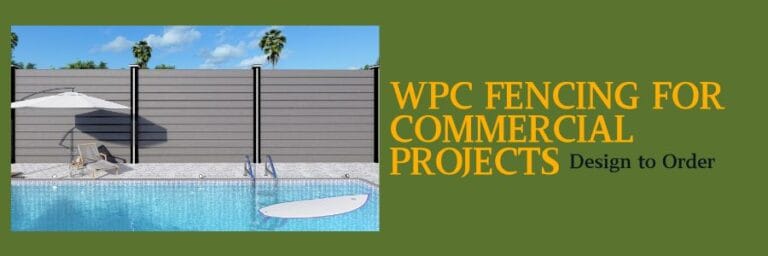
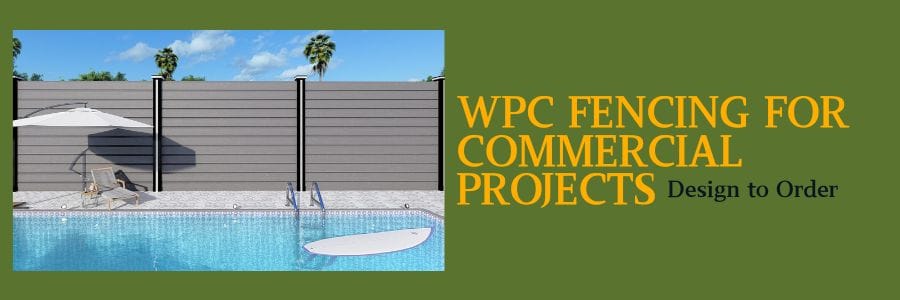
Commercial environments use fencing solutions to provide privacy, control visibility, and enhance branding. The sleek look and their array of choices make them a popular choice.
Fences can have various uses, depending on the context and the requirements of the space. For instance, there are 3 different situations in which a fence may be necessary. The terrace of the hotel must offer an area for relaxation with seclusion, and the restaurant terrace must have an open atmosphere yet still make room for hiding waste bins and service areas. A landscaped business park requires a neat, long fence.
A good system will provide a panel that fits with the site, installation, and purchasing requirements.

Start with Privacy: Full-Privacy or Semi-Privacy WPC Fencing?
Privacy is the first choice to make, because it decides how the whole fence looks and feels. Some areas need to be fully hidden, while others only need a gentle screen.
1. Full-Privacy Fencing for Secluded Outdoor Areas
Full-privacy fencing can be beneficial for outdoor settings where privacy is desired from other areas. It can be utilized in dining terraces, guest relaxation areas, and screening areas for services.
Full-privacy construction involves such materials as tongue-and-groove (T&G) WPC boards. They are designed to fit together without gaps visible between boards. Full privacy, however, does not mean solid core in fence boards, it means how well the fence hides the view. It can also be used for complete visual screening in a suitable closed configuration, using hollow WPC profiles.
The height of the fence should be determined by the natural eye level, not its appearance. Consider who may be able to see standing alongside the fence able to see over it.
Also, consider how the enclosure will affect the light and space. A large, tall fence can help to enclose a small patio area.
A large, tall fence can help close in a small patio space. Remember: There is no acoustic insulation in the presence of visual privacy.
2. Semi-Privacy Fencing for a More Welcoming Boundary
Semi-private fencing involves deliberately leaving gaps in the fencing. For example, horizontal open panels or a lower solid section with an open top. Consider visibility from different angles need to ensure that you are still able to enjoy good sight lines whilst providing some privacy to your seating or equipment. Consider sight lines from all angles and also how much you can see once it gets dark.
3. Combine Privacy Levels Across the Same Project
- For more privacy, use fully enclosed panels in the areas.
- Select open panels for visibility and/or access.
- Ensure that panels, finishes and post details are uniform throughout for a balanced look.
- Verify wind and structural loading for each panel configuration.
Apply Colour and Surface Design to the Fence to give it a Visual Identity
A plain boundary can be altered by using colour and texture. The proper mix can ensure that the fence blends into the building, surrounding plants and brand image.
Create a palette around the building and landscape
Warm timber shades are ideal for hotels and restaurants, and neutral greys for modern buildings. Darker shades can also help to create a more pronounced demarcation. Prior to final selection, preview specimens outside with the paving, building facade and plantings.
Set the colour of the WPC boards and metal parts (posts, trims etc.). Before ordering, agree on a reference sample with everyone so that you have a common finish to think of. Outdoor materials can alter in appearance over time as a result of exposure to sun and weather so request the supplier to provide evidence of colour stability and weatherability for the specific product.
Select WPC Surface Finishes for Commercial Settings
Textures give your product a certain appearance. You can choose between a traditional texture, 2D wood grain, and 3D embossed wood grain. The deeper the texture, the more natural it looks. Whereas a smoother texture will look neater and more modern.
Co-extruded WPC boards have a protective outer cap, which can also feature a wood-grain texture. This adds a different look to the boards than uncapped boards. Check samples, be sure they sound correct to you and that cleaning is easy.
Request product-specific documentation from the supplier, to back up weather and stain resistance claims. Once fitted, regularly clean the unit according to manufacturer’s maintenance guidelines and periodically re-check fixings for security.
Use Decorative Strips to Guide the Eye
Using a horizontal strip will help to create a flow along your long run. Using a vertical accent will highlight your entrance. Ensure your WPC infill is your main surface. Only using matching decorative elements in select areas. Check fixing, weather exposure, and movement room before approval.
Create Rhythm Along Long Commercial Boundaries
A consistent pattern in long commercial fences will make them look more organised. However, rather than varying the style for each section, limit the number of panel types and repeat them around the perimeter.
You can add feature sections at selected points to draw attention to seating areas, corners or access points. Simple changes that add some interest to the fence, but don’t create a lot of busyness.
Use consistent post spacing and trim lines during installation. This helps keep the fence neat and balanced in appearance, particularly from afar.

Make the Design Work on Slopes and Low Walls
Real sites are rarely flat or empty. Slopes, old walls, corners and gates all need a plan before the panels are chosen.
1. Choose a Slope Strategy Before Finalizing Panels
Compare stepped panels with slope-following layouts, where the system permits. Review level changes, bottom gaps, and privacy along the whole run. Confirm cutting, rail alignment, and post needs with the supplier before detailing non-standard sections.
2. Connect WPC Panels to Existing Low Walls
Check the wall is suitable for supporting the fence by considering the foundation, fixing method, edge clearances, and load distribution. Add the height of the wall to the height of the fence. Look from both sides. Ensure detail is available on coping, base plates and drainage to prevent ponding.
3. Resolve Corners, Gates and Ground Transitions
Prior to installation, determine all the corner angles, gate openings, and locations where the fence goes from wall-mounted to ground-mounted. These details help ensure there are no fitting issues and a consistent layout is achieved.
Ensure that the gates are suitably constructed to complement the fence, but also take into account the hardware/hinge and support needs of the fence. Don’t forget to draw in movement joints, drainage routes and future access points in the project drawings as these may be overlooked when installation or maintenance is required later.
4. Coordinate Fence Height, Post Spacing and Component Compatibility
Work together with the height, post spacing, openness of infill, wind exposure, and fixing type. The WPC will expand and contract with temperature changes. Allow expansion at the ends of the boards as detailed in the system instructions. Don’t copy the gap from another project. Ensure the boards, aluminium posts, rails, brackets and fittings have been approved to work together. If required, get it checked by the structural engineer.

Turn the Design into a Buildable and Orderable WPC Fence Package
An effective fence design should also be easy to cost, order and install. Create clear drawings and detail the complete scope of work prior to order. This will enable suppliers to know what is required, minimise delays in installation and prevent confusion and additional costs down the track.
1. Define Module Dimensions Clearly
The drawings and quotation should clearly show a few measurements and specifications:
- Bay width: The full width of one fence section.
- Clear infill width: Distance between posts where the boards fit.
- Post centre spacing: Distance between centres of two consecutive posts.
Use all three measurements in the drawings and quotation. Also include the fence height, board profile, post section, rails and accessories as a complete assembly. To prevent too small and too awkward gaps in the finished fence, plan the end sections in advance.
2. Separate Standard Options from Engineering Customization
Some options may be available, depending on supplier availability, tooling and testing. Colours, board lengths, wood grain and profile shapes can be customized. Also confirm movement allowances, supported spans, minimum order quantities, lead times and replacement supply before approving any custom part.
3. Composite Fencing Panels: A Manufacturer’s Role in Project Procurement
KR WPC is a China-based WPC manufacturer and overseas supplier. Its composite fencing panels are a useful starting point for a commercial scheme.
The range includes:
| Product | Best Use |
| WPC Co-extrusion Slat Fence Panel | A modern capped slat look |
| WPC Semi-Privacy Composite Fencing and Trellis / Semi-Privacy Panel | Open, welcoming boundaries |
| 2D Wood Grain Fence Panel and 3D Embossed Fence Panel | Different surface textures |
| WPC Grooved Fence Board | A closed, tongue-and-groove style |
| WPC Composite Fence with Solar LED Kit | Evening lighting along the boundary |
| Matching Aluminum Posts, Rails and Post Caps | Completing the fence as one system |
Buyers can send layout drawings, quantities and appearance needs to discuss product fit and supply. Ask for confirmed specifications, samples, compatible component lists and test documents. Don’t add any customisation options in the specification. Ask if the boards, posts, rails and fixings will have a system that works together. All structural design and fixing will be carried out by your design team and installer, unless the supplier can confirm in writing that they will do this.
4. Prepare a Complete RFQ and Approval Package
The RFQ will include levels, heights, quantities per bay, gate information, finishes and interfaces. Clearly define the scope of the work, what is to supplied, designed and installed.
Where possible provide a sample bay. The order should include minimum quantity, pack size, packaging for transit, labelling and delivery requirements. Agree batch numbers and finishes for repeat orders. Batches can vary slightly. Consider repair requirements. Ensure that individual boards can be replaced and order matching spare parts. New boards may appear slightly different to ones that have been weathered.
Conclusion
A good commercial fence combines a number of things: it’s the right level of privacy, it’s clearly identifiable, it transitions between the slope and the wall gently and gracefully, and it’s well-designed modules. A well-designed fence also requires parts that fit and installation specifications that have been verified.
When choosing your purchase, consider the long term appearance and maintenance and replacement. A low day one price is not much of a benefit if parts aren’t available later.
A next step is to draw a site plan and a specification list. Do this before you request samples and a project quotation.
Visit the KR ECO composite fencing to view the panel range, posts, rails, and accessories. Send your layout drawings, quantities, and finish needs to [email protected], and ask the team about samples and a project quotation.
FAQ
What information is needed for a commercial WPC fencing quotation?
Provide information on the required elevation, site contours, number of bays, gates, finish codes and how they will interface with the rest of the site. Identify who will be supplying, designing and installing the fence.
Which WPC fence dimensions and finishes can be customized?
Some products are available in different colours, lengths, wood grain finishes and profile shapes. Always check with your supplier that product is available, tooling is available and has been tested.
How are panel width, bay width and post spacing different?
Panel width is the width of the fence panel itself. Bay width is the full width of one section. Post spacing is the distance from the center of one post to the next. Each should be shown clearly on drawings.
Can composite fencing be installed on an existing low wall?
Possible. It will depend on the quality of your wall. Check the strength of the base, fixings, edge distances, and load distribution. Appearance alone does not show that a wall is suitable.
Can decorative strips be added to composite fence panels?
Yes, often, depending on the system. We would only add to certain areas. You would need to ensure that the fixings are correct, that they will be affected by weather, and that they have some scope for movement.