
Introduction: Why Material Selection Is Everything in Outdoor Architecture
Outdoor AC covers are deceptively demanding applications. They occupy a service niche that most building material specifications ignore — permanently installed structures that must simultaneously resist direct solar radiation, tolerate sustained heat exposure from the unit below, survive moisture cycling, and maintain their appearance across decades without maintenance. Choosing the wrong material is not a minor inconvenience. It is a structural and financial mistake that repeats every five to ten years.
This article examines the material science of wood plastic composite (WPC) as applied to exterior architectural details — specifically AC covers — drawing on publicly available product data, industry performance standards, and the technical principles that govern how these materials behave under real-world conditions.
Section 1: The Core Material Science of WPC
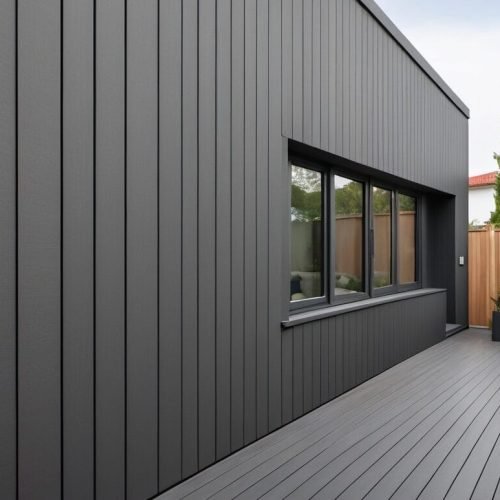
Wood plastic composite decking (WPC) is a hybrid material. It combines wood fiber (typically 40–60% by weight, sourced from wood flour, sawmill residues, or recycled wood) with a thermoplastic binder (polyethylene, polypropylene, or PVC being the most common). The two components are blended under heat, then extruded or molded into finished profiles.
The wood component provides stiffness, a natural appearance, and thermal stability — wood fiber has a lower coefficient of thermal expansion than unfilled plastics. The plastic component provides moisture resistance, dimensional consistency, and the ability to be extruded into complex cross-sectional geometries.
However, the simple binary of “wood + plastic” covers a vast range of formulation territory. The critical performance variables include:
Wood flour moisture content. Before compounding, wood flour must be dried to below 1% moisture content. Any residual moisture will flash to steam during extrusion, creating voids and bubbles within the profile — which degrades mechanical properties and surface finish. This is a manufacturing discipline that separates reliable producers from commodity suppliers.
Coupling agents and impact modifiers. Raw wood fiber and raw plastic are not naturally compatible — they have different surface chemistries. Coupling agents (typically maleic anhydride-grafted polyolefins) improve the bond between the two phases. Impact modifiers (rubber-based or acrylic core-shell particles) improve toughness. These additives are the invisible variable that determines whether a WPC profile is brittle and prone to edge cracking or genuinely durable.
UV stabiliser packages. The wood fiber component in WPC contains lignin, which is inherently UV-sensitive and will degrade when exposed to sunlight. Unprotected WPC will grey and chalk within 12–18 months. Quality producers incorporate UV absorbers (HALS compounds — hindered amine light stabilisers) and UV blockers (titanium dioxide or carbon black) into the formulation. The effectiveness of this package is directly measurable as colour retention performance over time.
Section 2: Co-Extrusion — The Performance Leap
Among the various WPC manufacturing processes, co-extrusion represents the most significant performance advancement for exterior applications.
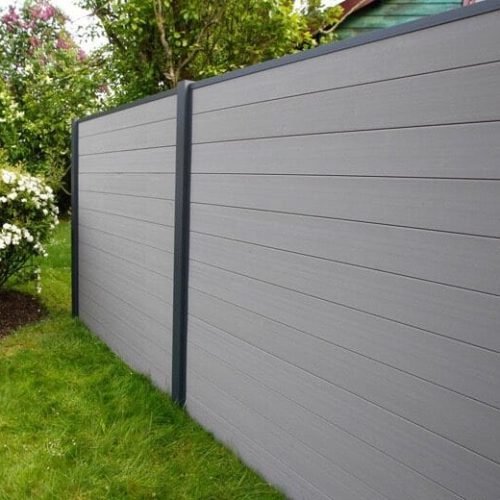
In co-extrusion, the core of the profile is a conventional wood plastic composite (the substrate). It is then encased — on all visible surfaces — by a continuous layer of unfilled polymer, applied in a second-stage extrusion die. This outer shell is 360° fused to the substrate with no adhesive layer — the two materials weld together during the process.
The result is a composite profile that combines the structural and thermal properties of the core WPC substrate with a dense, non-porous, highly weather-resistant outer surface.
The performance data from production-grade co-extrusion WPC — as documented by manufacturers in the sector — is specific:
Water absorption rate: 0%. The polymer shell has no open porosity. Standard hollow-core or uncapped WPC will absorb moisture through capillary pathways at the wood-plastic interface, typically reaching 2–5% moisture content over 24 hours of water immersion. This absorption drives swelling, delamination, and loss of mechanical strength over freeze-thaw cycles. Co-extrusion eliminates this mechanism entirely.
Colour retention: 25+ years without visible fading. The unfilled polymer shell resists UV degradation far more effectively than wood fiber-containing compounds. The difference is measurable: uncapped WPC typically reaches Delta E 4.0 (per CIE Lab colour measurement) within 2–3 years of UV exposure; co-extrusion profiles typically maintain Delta E below 2.0 after 1,000 hours in accelerated xenon-arc weathering testing.
Scratch resistance: 3–4× higher than uncapped profiles. The polymer shell is harder and more abrasion-resistant than a wood fiber-loaded compound. For a horizontal or semi-vertical cover application, this matters: accidental impacts from garden equipment, sliding objects, or cleaning tools are the most common causes of surface damage.
Stain and chemical resistance. The non-porous surface does not allow oils, greases, or organic debris to penetrate. Standard cleaning with soap and water is sufficient. Mould and mildew — the most common exterior maintenance problem for organic materials — cannot establish root systems in the surface because there is no organic content for hyphae to penetrate.

Section 3: Profile Geometry — Why Extrusion Shape Matters
One advantage of WPC over conventional building materials is that the cross-sectional profile is determined by the extrusion die — not by the limitations of a sawmill or metal forming process. This allows precise, repeatable geometry at scale.
For exterior architectural applications, the most relevant profile variables are:
Solid versus hollow cores. Solid WPC profiles have higher density (typically 1.2–1.4 g/cm³ versus 0.7–0.9 g/cm³ for hollow), which translates to better load-bearing capacity and superior sound insulation. Hollow profiles reduce material cost and weight. For an AC cover, where the structure must resist wind loads, maintain geometry under thermal cycling, and support its own weight without sagging over long spans, a solid or engineered hollow profile with adequate wall thickness is technically superior.
Slat-type profiles for ventilation architecture. The slat profile — a flat, relatively thin cross-section — is ideal for AC covers because it allows precise, engineered spacing. The open fraction (the ratio of gap width to slat width) directly determines airflow resistance. Unlike wood slats, which vary dimensionally with humidity, WPC slats maintain their spacing permanently, ensuring consistent ventilation performance throughout the product’s service life.
Surface texture options. WPC extrusion surfaces range from smooth (lowest cost, easiest to clean) through brushed or wire-brushed (medium texture, better scratch concealment) to deep embossed (wood-grain texture, highest slip resistance). For an AC cover, the relevant consideration is a balance between aesthetic finish, ease of cleaning, and the tactile quality appropriate for the installation context.
Section 4: Extrusion Tolerances and Why They Matter for Installation
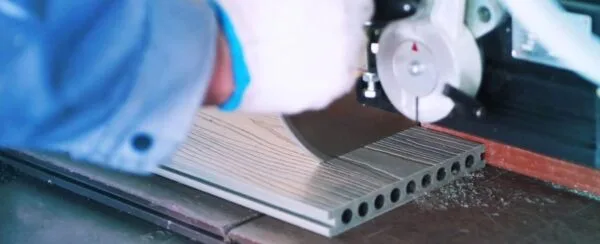
Precision extrusion gives WPC another practical advantage: tight dimensional tolerances.
Certified WPC profiles are manufactured to ±0.3mm dimensional tolerance on critical dimensions (width, thickness). Wood, by comparison, has typical kiln-dried dimensional tolerances of ±1–2mm, and these dimensions shift seasonally with ambient humidity. Metal fabrications (aluminium, steel) can hold tighter tolerances but are subject to thermal expansion coefficients that are 2–3× higher than WPC — meaning a 1-metre aluminium panel will expand 2.4mm over a 40°C temperature swing, versus approximately 0.4mm for a comparable WPC panel.
For a KD (knock-down) assembly system — where multiple components must fit together without adjustment, drilling, or modification — this dimensional consistency is not a luxury. It is a prerequisite for a reliable, repeatable installation.

Section 5: Service Life and Total Cost of Ownership
The industry data for premium WPC — specifically co-extrusion composite decking and cladding — reports service lives of 25 years (for capped/co-extrusion profiles) and 60+ years (for certain solid-section formulations) under normal exterior conditions. This compares to 5–10 years for painted timber, 10–15 years for powder-coated steel in benign environments, and 15–20 years for anodised aluminium in moderate climates.
The maintenance profile is equally distinct. Premium WPC requires no painting, sealing, or staining. The recommended maintenance for exterior WPC cladding or fencing in temperate climates is two cleans per year with water and a soft-bristle brush. Mould and mildew, if present, can be addressed with commercial composite cleaners or a vinegar-water solution. Tannin stains — common in the first six months as the surface oxidises — are self-correcting as the UV stabilisers take effect, or can be treated with oxalic acid-based brighteners.
Conclusion: Coherence in Outdoor Detail Systems
The technical data suggests a clear conclusion: WPC co-extrusion composite is the material of choice for exterior architectural details that must perform across multiple environmental stresses without ongoing maintenance intervention. Its dimensional stability, zero water absorption, UV resistance, and long service life are not theoretical — they are documentable material properties that derive from the formulation and extrusion process.
For specifiers, the implication is that AC covers should be evaluated on the same technical basis as the decking, cladding, and fencing that surround them. When the surrounding exterior system is specified as WPC — for reasons of durability, maintenance-free performance, and design coherence — it is technically inconsistent to specify timber or uncoated metal for the cover itself. The material science does not support that distinction.